
CCSP or SOURCE? How to Tell Which One Fits
Both pay for the same care at home. The differences that actually matter to a family come down to income, whether there's a queue, and what happens to a spouse still living at home.
September 24, 2026 · 2 min read
Georgia's Elderly & Disabled Waiver Program is delivered two ways, and families are often handed both names with no explanation of the difference. Here is the short version.
They cover the same services
This is worth saying first, because it removes most of the anxiety. Personal support, respite care, skilled nursing, adult day health, home-delivered meals, emergency response — both CCSP and SOURCE cover them. You are not choosing between a good programme and a lesser one.
Where they differ
Income
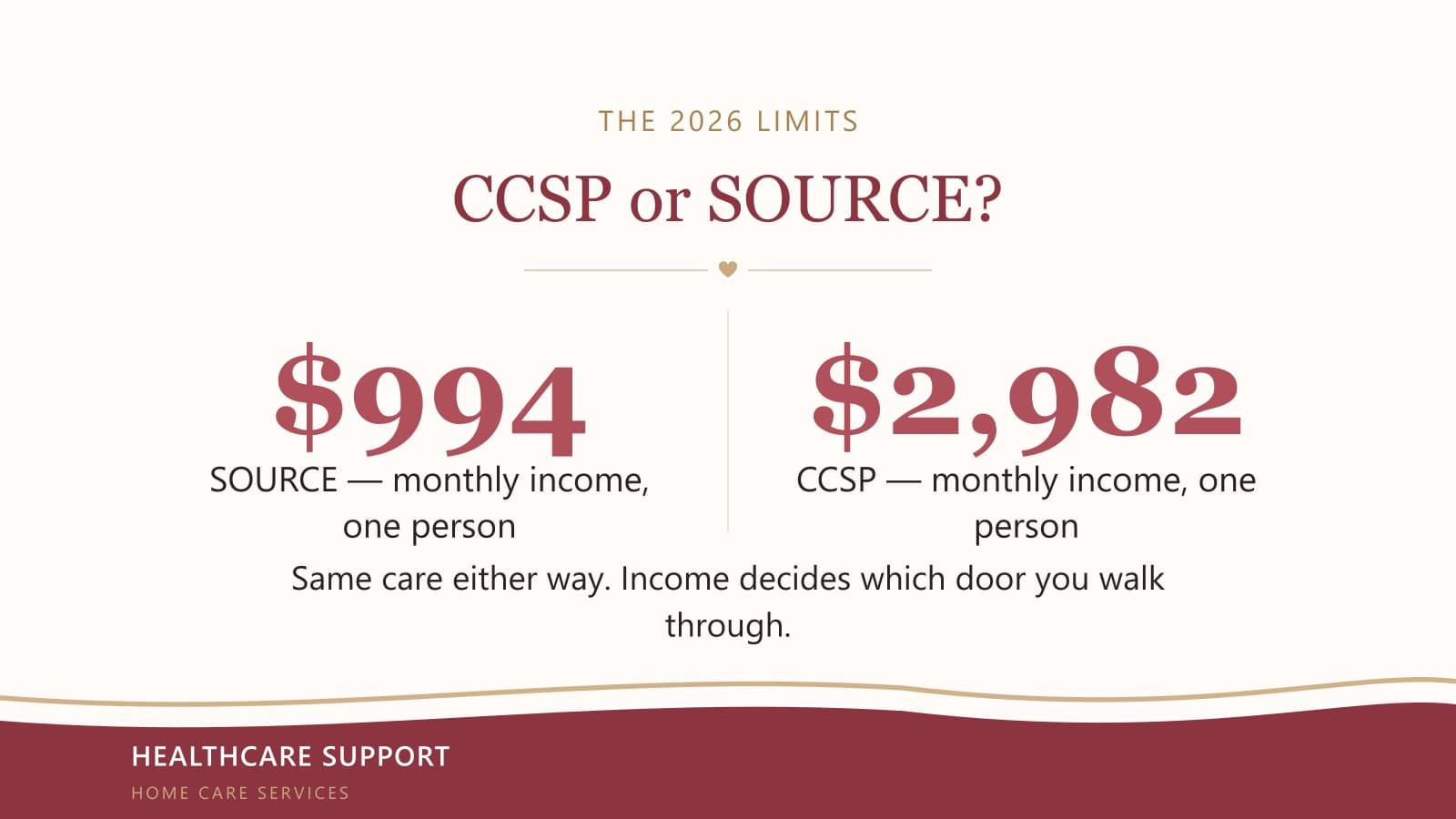
This is the main dividing line. SOURCE is capped at the SSI benefit rate — $994 a month for one person in 2026, or $1,491 for a couple where both apply. CCSP allows up to $2,982 a month for one person, or $5,964 for a couple.
So for most families, income decides it rather than preference.
A spouse still at home
If one person needs care and the other does not, this matters enormously. CCSP has full spousal protections: the spouse at home is allowed to keep a meaningful share of income and savings. SOURCE has none.
For a married couple where only one needs care, CCSP is very often the better route even when SOURCE is technically available.
Waiting
SOURCE has no waiting list. CCSP is not an entitlement — there are a limited number of slots, and when they are full a queue forms. If timing is urgent and income allows SOURCE, that weighs in its favour.
A coordinating doctor
SOURCE assigns a primary care physician who works alongside your case manager. Some families find that genuinely valuable; others already have a doctor they trust and see it as an extra relationship to manage.
What is identical
- The asset limit: $2,000 for one person, $3,000 for a couple where both apply.
- The level of care test: an intermediate nursing facility level of care, assessed through a functional assessment called the DON-R.
- Georgia residency, and being 65 or over, or an adult under 65 with a physical disability.
The thing families get wrong about assets
That $2,000 figure frightens people off, and it should not. The home does not count. Neither do its contents, personal effects, or one vehicle. What counts is bank accounts, savings and investments.
We have lost count of the families who ruled themselves out because they owned a house, and who would have qualified comfortably.
If income is over the limit
Still not the end of it. Georgia allows a Qualified Income Trust — often called a Miller Trust — which holds the income above the limit and makes an application possible. It is routine, and we can point you to someone who sets them up.
Not sure which applies?
You do not have to work it out. Our two-minute eligibility check does the comparison for you and tells you which one is the likely fit.
Wondering whether the Medicaid waiver could cover care for your family?
Check in two minutes